
Reviewed · WALKING TOURS
Walking in Valencia
Valencia reveals its story through buildings rather than big speeches. This private walk links the tiled Estació del Nord, Art Nouveau markets, Gothic towers, Baroque decoration, and the old center in one easy route. I like the strong architectural variety and the chance to finish at Mercado de Colón, a good place to try horchata. I also like that guide Enrique can explain local customs and answer questions in several languages.
The main point to consider is pace. The tour lasts about two to three hours, yet most listed stops are brief, often only four or five minutes. You’ll get a useful city introduction, but not a long visit inside every major building.
In This Review
- Key points at a glance
- From Estació del Nord into Valencia’s grand center
- Central Market and La Lonja: Valencia’s working heart
- Plaza Redonda and the small-scale old town
- The Cathedral quarter at Plaça de la Reina
- Serranos Towers and the old Turia river
- The Marqués de Dos Aguas facade
- Finishing at Mercado de Colón with horchata nearby
- What Enrique adds to the walk
- Pace, group size, and practical value
- Who should book this Valencia walk?
- Should you book Walking in Valencia?
- FAQ
- Where does the walking tour start?
- What time does the tour begin?
- Where does the tour end?
- How long does the experience last?
- Is the tour offered in English?
- Is this a private tour?
- Who is the guide?
- Does the tour include entry tickets to the attractions?
- Is the tour suitable for most people?
- What happens if the weather is poor?
Key points at a glance
- Eight central Valencia sights: The route runs from Estació del Nord to Mercado de Colón, covering major old-town landmarks along the way.
- A lesson in city design: You’ll see Belle Époque, Art Nouveau, Gothic, and Baroque styles within one walk.
- Private format: Only your group takes part, so you can ask questions and keep the discussion focused.
- Enrique leads the walk: He is described as friendly, punctual, flexible, and able to guide groups in multiple languages.
- A practical 5 p.m. start: The late afternoon departure gives you a useful first look at the center without using your morning.
- A food stop at the finish: Mercado de Colón is a natural place to try horchata after the walking route.
From Estació del Nord into Valencia’s grand center
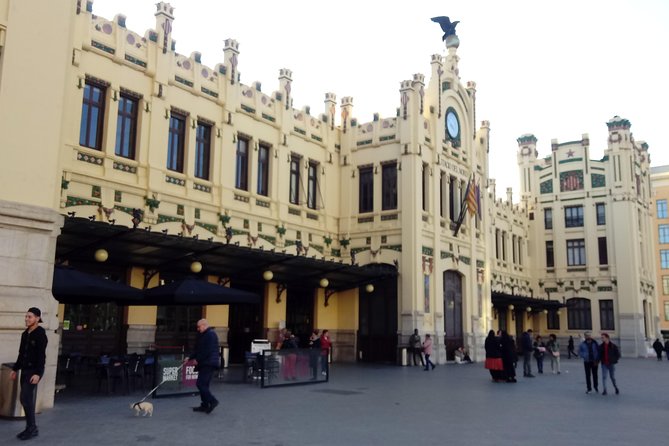
The walk starts at València-Estació del Nord, on Carrer d’Alacant, at 5 p.m. This is a smart meeting point. You are beginning at one of Valencia’s most expressive public buildings, not at a generic street corner.
The station is known for its mosaic decoration, and the opening stop gives you a quick look at the city’s early 20th-century confidence. The visit here is listed at about five minutes, so think of it as an introduction to the facade and decorative details rather than a full architectural study.
I like starting here because it gives you an immediate visual clue about Valencia. The city can feel like a mix of old stone, modern commerce, and Mediterranean ease, but the station shows how much care went into public design during the Belle Époque period.
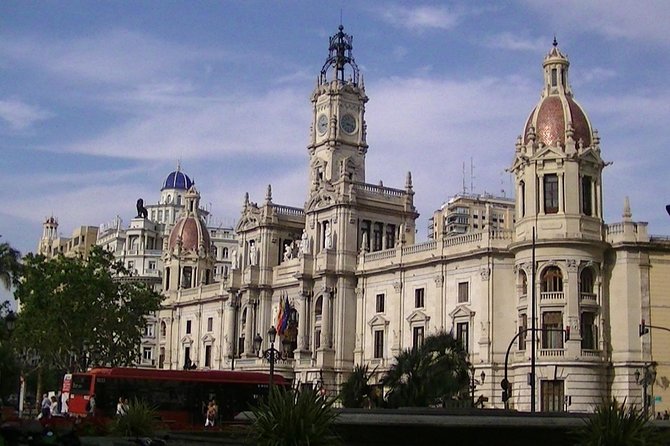
From the station, the walk continues to Plaça de l’Ajuntament, the Town Hall Square. The square and the Post Office help complete the Belle Époque picture. Together with Estació del Nord, these buildings show how Valencia presented itself as a modern European city in the 20th century.
Again, the stop is short, around five minutes. That works well if you want orientation and context before exploring independently. If you are hoping to enter the Town Hall or study the Post Office interior, you should plan a separate visit.
More walking tours in Valencia:
- Valencia: Essentials and World Heritages Sites Walking Tour
★ 4.7 · 684 reviews - Valencia: Historical Walking Tour
★ 4.6 · 390 reviews - Valencia: City Walking Tour with Top Attractions – ITALIAN
★ 4.9 · 242 reviews
Central Market and La Lonja: Valencia’s working heart
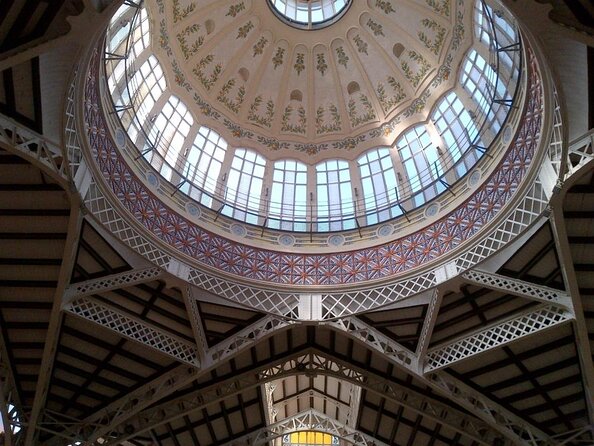
The route then moves into the center, where two of Valencia’s most important buildings face each other: Mercat Central de València and La Lonja de la Seda, the Silk Market.
Mercat Central is an Art Nouveau building opened in 1928. Even a short look helps you understand why food markets matter so much to Spanish city life. The market is not presented as a long shopping stop here. Instead, Enrique uses it to explain the city center and the relationship between commerce, architecture, and daily life.
Across from the market is La Lonja, the 15th-century Silk Market. The supplied route calls it the diamond of Valencia, and the comparison makes sense as a way to mark its importance. The market represents a later period of city growth, while La Lonja points back to Valencia’s medieval trading power.
The stop is listed at about four minutes, so keep your expectations in line. You are seeing the setting and hearing the story, not taking a full guided tour of both buildings. I find that useful on a first afternoon because it helps you decide which places deserve a return visit.
If you have time after the walk, the Central Market is one of the places I would revisit at a slower pace. The tour gives you the background. A second visit lets you pay attention to the food stalls, building details, and ordinary rhythm of the market.
Plaza Redonda and the small-scale old town
Next comes Plaza Redonda, the Round Square. Its circular layout makes it one of the more unusual spaces in central Valencia. It was renewed, but the shops still carry handmade goods linked to older local traditions.
The stop lasts about five minutes. That is enough to understand the shape of the square and the kind of shopping associated with it. It is not a major museum visit, and the route does not promise time for browsing every shop.
I like this stop because it changes the scale of the walk. The grand station, Town Hall, and market buildings show civic ambition. Plaza Redonda is more intimate. It gives you a glimpse of craft selling and small shops within the old center.
This is also a place where your own interest matters. If you enjoy local handwork, you may want to return later. If shopping is not your priority, the guide’s explanation and the unusual architecture are likely to be enough.
The Cathedral quarter at Plaça de la Reina
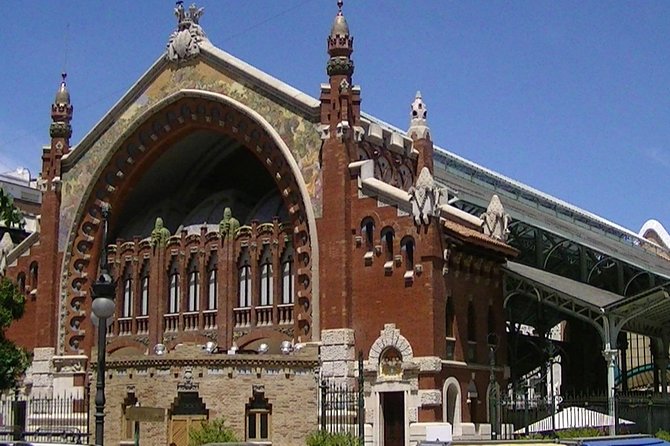
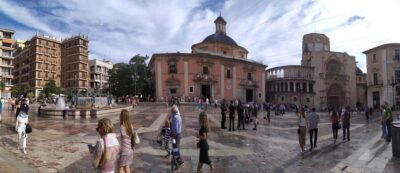
Plaça de la Reina is one of the route’s most important points. The square introduces the Cathedral, the Micalet Tower, and the nearby Plaza de la Virgen. Together, these places form one of the clearest symbols of Valencia’s old center.
The stop is listed at about ten minutes, making it longer than most earlier stops. That extra time matters. This is the part of the walk where you can begin to connect architecture, religion, public space, and city identity.
The route describes the area as a place of art and culture. Enrique’s role here is especially useful because a good explanation can turn a group of impressive buildings into a readable city scene. You can ask about the Cathedral, the tower, or the way the surrounding squares relate to one another.
Do not expect a full Cathedral tour from this walk. The itinerary focuses on seeing the landmarks and understanding their place in the old town. If you want to examine religious art or climb the Micalet Tower, you would need extra time outside the tour.
For first-time visitors, this is probably the point where Valencia begins to feel less like a collection of attractive buildings and more like a city with layers. The route has moved from modern public architecture to medieval trade and then into the historic religious center.
A different way to spend a day in Valencia:
- Valencia: Oceanogràfic Entry Ticket
★ 4.7 · 9,893 reviews - Valencia: 24 or 48-Hour Hop-on Hop-off Bus Ticket
★ 3.9 · 5,611 reviews - Valencia: Palosanto Flamenco Show Ticket
★ 4.8 · 3,876 reviews - Valencia: Catamaran Cruise with Sunset Option
★ 4.0 · 3,566 reviews
Serranos Towers and the old Turia river
After walking along Serranos Street, the group reaches Torres dels Serrans, or the Serranos Towers. The towers are Gothic and once formed part of Valencia’s defensive system.
The stop takes about five minutes, but the subject is larger than the clock suggests. Enrique explains how important the Turia River was to the city’s development. That gives the towers a useful setting. They were not simply built as decoration. Their location and purpose were tied to the city’s defenses and to the river that shaped Valencia.
This is a good example of why a guide can add value even when the stop is short. A tower can be photographed in seconds. Understanding its connection to the old city and the Turia gives the view more meaning.
The route does not say that you enter the towers, so plan on seeing them from the outside during the walk. If you want a detailed look inside, check separately before booking other activities around this tour.
The Marqués de Dos Aguas facade
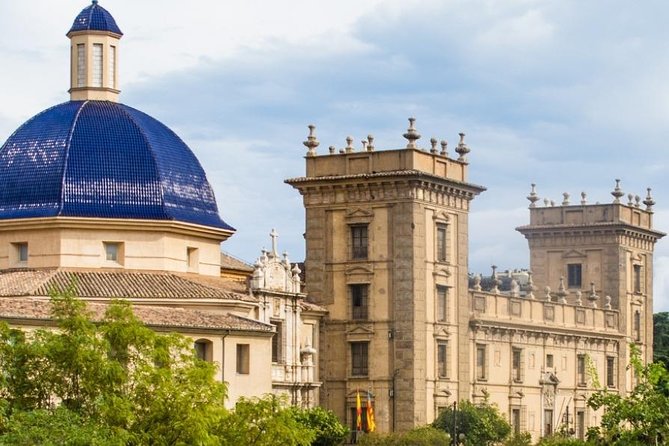
The next landmark changes the mood again. Palacio del Marqués de Dos Aguas is known for its extraordinary facade and Baroque style. The building houses the National Ceramic Collection.
The listed stop is only about four minutes, so the focus is clearly the exterior. That is not a bad thing. The facade is the sort of city detail that is easy to miss if you rush from one famous square to another. Here, the tour pauses to point out decoration that deserves a close look.
I would treat this as a preview rather than a museum visit. If ceramics, decorative art, or Baroque interiors interest you, the National Ceramic Collection may deserve a separate visit. The walking tour helps you locate it and explains why the building matters, but it does not leave enough time for a complete museum experience.
This stop also adds balance to the route. You have seen Gothic defenses, medieval commerce, and Art Nouveau public buildings. The palace brings in aristocratic display and decorative excess.
Finishing at Mercado de Colón with horchata nearby
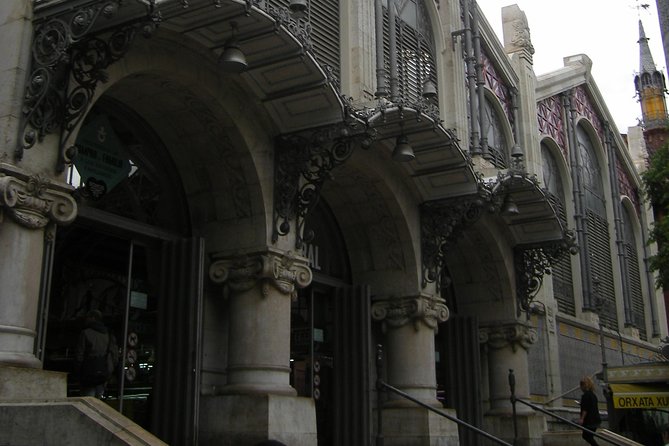
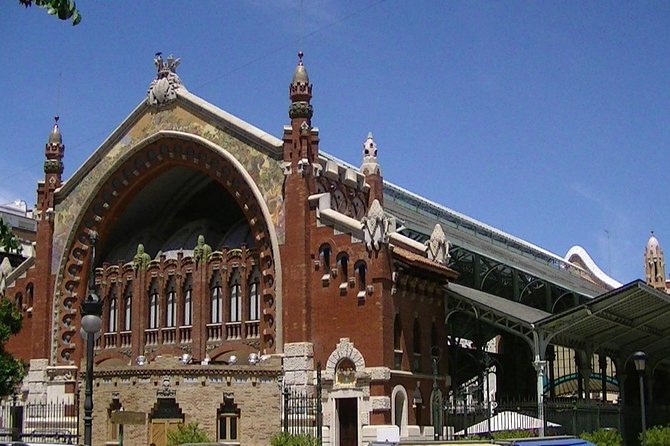
The walk ends at Mercado de Colón, another Art Nouveau building. It opened in 1916 and was renewed in the 21st century. Today, it works as a meeting place in the center, close to Calle Colón and the city’s shopping area.
The end point is well chosen. You finish somewhere pleasant and practical rather than at an isolated monument. After two to three hours on foot, you may want a seat, a drink, or a plan for dinner. Mercado de Colón gives you an easy next step.
This is the recommended place to try horchata, Valencia’s traditional beverage. The tour does not say that a tasting is included, so plan to buy it yourself after the walk. Ending here lets Enrique introduce the drink and then lets you decide if you want to stay.
The route’s final building also mirrors its opening. Estació del Nord and Mercado de Colón both show Valencia’s love of Art Nouveau design, but they serve different purposes. One was built for rail travel. The other now functions as a social and food meeting point.
What Enrique adds to the walk
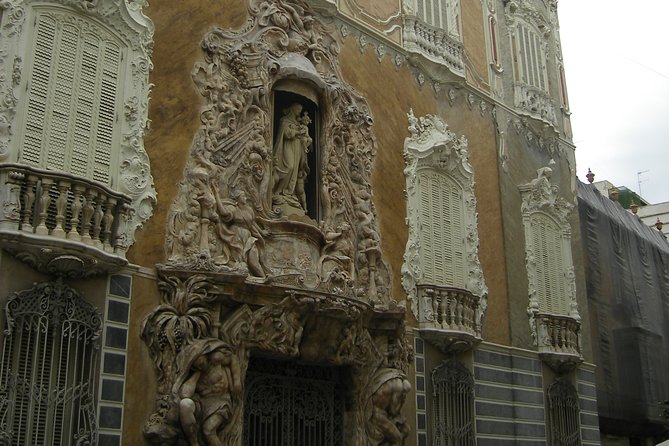
The guide named in the supplied information is Enrique. The strongest praise focuses on his manner, language skills, punctuality, flexibility, and ability to explain both major historical points and small details about buildings.
That combination matters. A city walk can become a list of dates, or it can help you read what you are seeing. Enrique is described as able to conduct the tour in multiple languages without leaving anyone out, which is useful for mixed-language groups.
He is also described as friendly and encouraging, with a willingness to answer many questions. One booking was postponed when a participant became ill, showing a practical level of flexibility. That does not guarantee every schedule change will be possible, but it gives you a sense of the personal approach attached to this experience.
One piece of criticism is worth keeping in mind: the pauses between stories could sometimes feel too long, and one person wanted more content. The walk is generally presented as informative and entertaining, but the amount of explanation may depend on group questions, walking speed, and the guide’s rhythm.
Pace, group size, and practical value
This is a private tour, so only your group participates. That is the clearest value advantage. You are not sharing the walk with a large crowd, and you can ask about the buildings that interest you most.
The tour runs for roughly two to three hours. The listed stops add up to less time than that, which means the rest is spent walking between sights and hearing explanations along the way. That is normal for a city walk, but it also explains why you should not treat the experience as eight separate building tours.
The 5 p.m. start works well for several kinds of visitors. You can use the morning for a museum or market visit, then meet near the train station in the late afternoon. The route ends near shopping on Colón Street, so you can continue into the evening from there.
You should be comfortable walking for several hours and standing during short explanations. Most people can participate, and service animals are allowed. The meeting point is near public transportation, which makes the start convenient if you are staying elsewhere in Valencia.
No price is supplied here, so I cannot judge the exact cost. The private format, personal guide, language flexibility, and route through eight central sights are the main things to weigh against the price. If the fee is similar to a standard group walk, the private arrangement looks particularly useful. If it is much higher, book it for the guide access and tailored questions, not simply for seeing the buildings.
Confirmation arrives at booking. The experience requires good weather. If poor weather cancels the tour, you are offered another date or a full refund. You can cancel for a full refund up to 24 hours before the 5 p.m. start time. Changes or cancellations inside that 24-hour window are not refunded.
Who should book this Valencia walk?
I would choose this tour for a first visit, especially if you want a clear framework before exploring Valencia on your own. The route connects the train station, civic center, markets, old-town squares, city defenses, a Baroque palace, and a later Art Nouveau meeting place.
It also suits you if buildings matter more than a long food tour or a single museum. You will see a wide range of styles and hear how commerce, defense, religion, and public life shaped the city.
It may be less suitable if you want extended time inside the Central Market, La Lonja, the Cathedral, or the National Ceramic Collection. The route gives you introductions and outside views, not lengthy admissions or guided interior visits.
Should you book Walking in Valencia?
Book it if you want a private, well-organized first look at central Valencia with a guide who can explain the city in several languages. Enrique’s friendly style, punctual approach, and attention to questions are the main reasons to choose this walk.
Skip it if you prefer to explore slowly, spend a long time in museums, or stop often for food and shopping. The short pauses keep the route moving, but they can feel brief if you want detailed visits.
For most first-time visitors, I see this as a useful orientation walk. Pay attention to the places you want to revisit, especially the Central Market, La Lonja, the Cathedral quarter, and the Marqués de Dos Aguas palace. Then finish with horchata at Mercado de Colón and continue your evening from there.
FAQ
Where does the walking tour start?
The tour starts at València-Estació del Nord, Carrer d’Alacant, 25, Extramurs, 46004 València, Valencia, Spain.
What time does the tour begin?
The start time is 5 p.m.
Where does the tour end?
The walk ends at Mercado de Colón in the Ensanche area of central Valencia, near Colón shopping street.
How long does the experience last?
The walking tour lasts approximately two to three hours.
Is the tour offered in English?
Yes. English is one of the offered languages.
Is this a private tour?
Yes. Only your group participates in the activity.
Who is the guide?
The guide named in the tour information is Enrique.
Does the tour include entry tickets to the attractions?
The stops are marked as having admission included, but the itinerary describes brief visits at several locations and does not specify extended interior visits. Check the booking details if entry inside a particular building is important to you.
Is the tour suitable for most people?
Yes. Most people can participate, and service animals are allowed. The experience is near public transportation.
What happens if the weather is poor?
The experience requires good weather. If it is canceled because of poor weather, you will be offered a different date or a full refund.
Just added around Valencia
- e-Bike Rental in Valencia★ 3.5 · 3 reviews
- Valencia: Horchata Bike Tour★ 4.8 · 3 reviews
- Valencia: Tuk Tuk Historical Tour★ 5.0 · 3 reviews
- Authentic Paella Dinner in Valencia★ 5.0 · 3 reviews
- Valencia: Guided City Walking Tour with Tapas Tastings★ 3.8 · 3 reviews
- One-way Valencia Airport To/From Benicàssim (FIB)★ 5.0 · 3 reviews
- Rent Boat Valencia Yatch Polonova with capitan and drinks★ 4.0 · 3 reviews
- In Love with Valencia: A Self-Guided Tour of its Landmarks★ 5.0 · 3 reviews
Walking Tours, compared.
Essentials and World Heritages Sites Walking Tour
Read our review →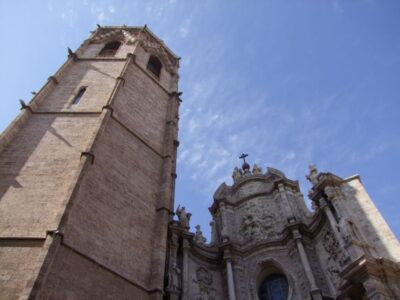
City Walking Tour with Top Attractions – ITALIAN
Read our review →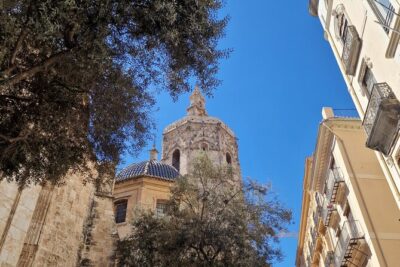
Valencia Private Walking Tour with Official Valencian Guide
Read our review →
The 10 Tastings of Valencia With Locals: Private Food Walking Tour
Read our review →
Browse the lists this tour appears in